
How Multi-Model AI Could Create a New Approach to Clinical Decision Support
Multi-Model AI combines specialized models to enhance Clinical Decision Support, enabling healthcare organizations to analyze diverse data and deliver smarter, safer decisions.
 Author: Rony Sebastian
Redefining Clinical Decision Support Through Multi-Model AI Systems
A senior physician called us recently with a question that sounded simple on the surface: could he use an AI tool to type in a patient's symptoms and history, and get back something useful, maybe a new diagnosis angle he hadn't considered, or a flag on a clinical condition worth ruling out?
Then came the real question, the one that actually matters: could he paste those patient details into the tool, and then copy the AI's response back into the EHR?
That second question is the one every healthcare CXO should be asking before the first one gets answered.
The Convenience Trap
It's easy to see the appeal. A general-purpose AI model feels fast, capable, and available right now. But "available right now" and "safe for patient data" are two very different things. Once patient information leaves a governed system and enters a public AI tool, an organization loses control over where that data goes, how it's stored, and whether it's used to train something else entirely. Copying the output back into the EHR doesn't undo that exposure. It just hides it inside the chart.
This isn't really a story about one physician being careless. It's a story about a gap: clinicians want AI-assisted answers inside their workflow, and most health systems haven't built anywhere safe for that to happen yet. When there's no sanctioned option, people improvise with whatever is fastest.
So the real fix isn't telling clinicians not to use AI. It's building a Clinical Decision Support environment that gives them what they're already trying to get, without the copy-paste risk.
Why One Model Was Never Going to Be Enough
Part of the reason clinicians reach for a general AI tool is that clinical decision-making pulls from very different kinds of data: structured EHR fields, free-text clinical notes, imaging, lab values, vitals over time. A single general-purpose model can touch all of these, but touching something and being the right tool for it aren't the same thing.
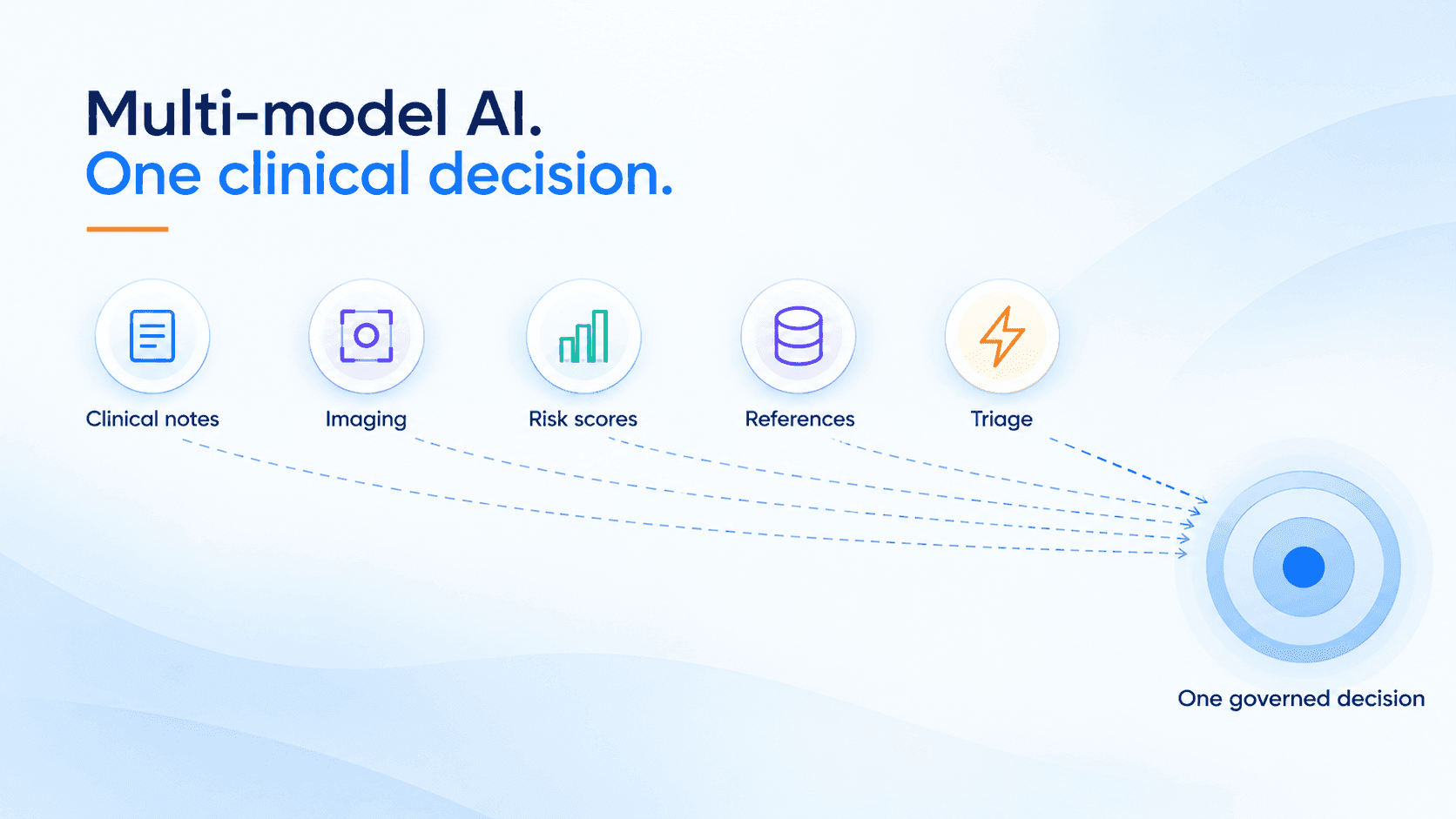
A more deliberate approach uses a small set of specialized models, each doing what it's actually good at:
- A language model for interpreting clinical notes and documentation
- A vision model for imaging
- A predictive model for risk scoring
- A retrieval system pulling from validated clinical references
- A lightweight model for high-volume, low-risk classification tasks
The goal isn't to collect models. It's to match the model to the clinical problem, then let them work together.
What Orchestration Actually Looks Like
Picture a workflow where a clinician's question triggers a few things at once, inside the health system's own environment: a language model reads the relevant chart notes, a predictive model checks risk factors, an imaging model flags anything notable in a recent scan. Instead of three disconnected answers, the system combines them into one structured view for the clinician to act on.
The clinician isn't manually feeding data to each model, and nothing leaves the organization's controlled environment to get there. That's the difference between "using AI" and "using AI safely."
It also means the system can evolve piece by piece. If a better imaging model comes along next year, it can be swapped in without touching the rest of the architecture.
Governance Doesn't Get Easier With More Models. It Gets More Necessary.
Adding models doesn't automatically make a system safer. It adds new questions: which model produced this output, what data did it touch, what happens when two models disagree, and when should this stop and go to a clinician instead of past one.
A well-built Multi-Model AI setup answers those questions by design: clear versioning, access controls, audit trails, defined escalation paths, and a documented boundary around what the system is allowed to do without a clinician's review. None of that is optional if the output is going to influence a chart.
The Bottom Line for CXOs
The physician's question wasn't really "can AI help me?" It was "is there a safe way to get this help without exposing my patients?" Right now, for a lot of health systems, the honest answer is no, not yet.
That's the gap worth closing. Not by restricting what clinicians want to do, but by giving them a properly governed version of it, built into the workflow instead of bolted on through a browser tab.
Building a Clinical AI Foundation
The organizations that get ahead of this won't be the ones that adopted the flashiest AI model first. They'll be the ones that gave their clinicians a safe, built-in way to ask the question in the first place.
Softnotions helps U.S. healthcare organizations design and build Multi-Model AI architecture for Clinical Decision Support, including model integration, healthcare data engineering, EHR and API interoperability, secure workflow development, and human-in-the-loop oversight.
The goal isn't just deploying more AI. It's making sure every model in the workflow has a defined role, a documented boundary, and a clinician still firmly in the loop.
Let's work together to solve your business challenge
Connect with us and let's start the journey toward your next breakthrough.
Schedule a Discovery Call
Rony Sebastian
CEO
With over 20 years of experience in technology leadership and digital transformation, I help healthcare organizations and enterprises build secure, scalable, and AI-powered digital platforms that drive operational efficiency, innovation, and business growth.
As the Founder & CEO of Softnotions, I lead a trusted digital engineering company focused on building secure, compliant, and scalable technology solutions for the US healthcare ecosystem. Our expertise spans Digital & SaaS Product Engineering, Data Platform & Integration Engineering, AI, Analytics & Automation, and Governance, Risk & Compliance (GRC).